By Arvell B. Anthony
Fear is incredibly persuasive.
It sounds responsible.
It asks practical questions.
What if it doesn’t work?
What if you lose money?
What if nobody buys?
What if the opportunity doesn’t come?
What if you fail?
What if you’re making the wrong decision?
Those questions can sound like wisdom.
Sometimes they’re useful.
But sometimes fear isn’t protecting us.
Sometimes it’s quietly designing our entire life.
The questions we ask matter
I’ve been thinking about the difference between asking:
“How do I avoid failing?”
and asking:
“What am I trying to build?”
They sound similar.
They’re not.
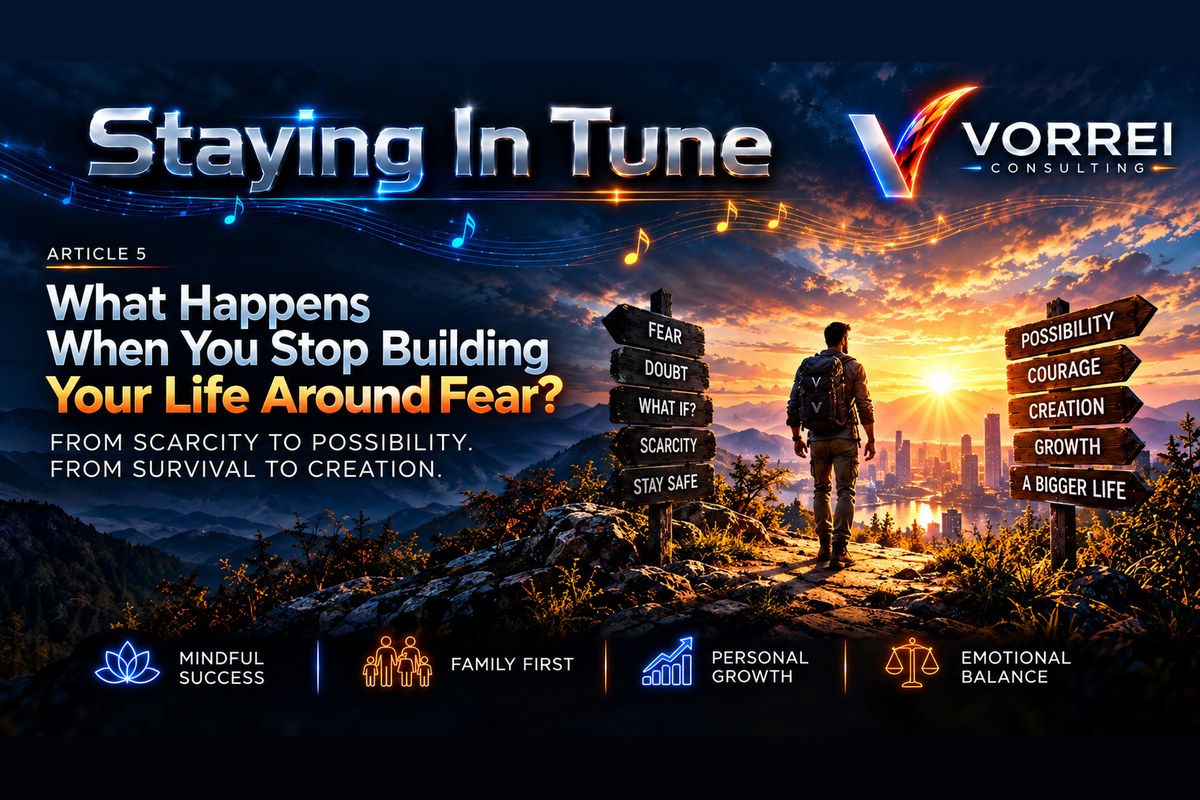
The first question is organized around fear.
The second is organized around possibility.
And whichever question you ask tends to influence what you see next.
The scarcity mindset
When we’re afraid, our world gets smaller.
We focus on what might disappear.
Money.
Security.
Status.
Approval.
Predictability.
We begin making decisions primarily to prevent loss.
That can be useful in an emergency.
But it’s a terrible long-term operating system.
Because life becomes less about creating something meaningful and more about avoiding something painful.
And those are very different ways to live.
Choosing possibility
I’ve recently found myself in a situation where it would have been very easy to focus entirely on security.
Instead, I decided to focus on possibility.
Not because I believe everything will magically work out.
Not because uncertainty isn’t real.
And not because planning doesn’t matter.
It does.
But I also believe that constantly staring at the thing you’re afraid of doesn’t make you safer.
Sometimes it simply makes you more afraid.
So I started asking different questions.
What do I actually want?
What kind of business do I want to build?
What kind of clients do I want to serve?
What kind of work energizes me?
What kind of life do I want my business to support?
What can I create?
Where can I add value?
What would I attempt if I wasn’t constantly trying to protect myself from failure?
Those questions created energy.
Faith and action
There is an important distinction between having faith and being passive.
Faith doesn’t mean sitting around waiting for the universe to deliver something.
For me, faith means doing my part while accepting that I don’t control the entire outcome.
I can prepare.
I can build.
I can make calls.
I can create.
I can serve.
I can learn.
I can show up.
Then I have to release the need to control exactly how everything unfolds.
That’s difficult.
But it’s freeing.
What fear costs us
Fear has a hidden cost.
It can prevent us from taking opportunities.
It can make us hesitate too long.
It can cause us to underprice our work.
It can make us stay in environments we’ve already outgrown.
It can make us prioritize certainty over fulfillment.
It can cause us to confuse comfort with security.
And perhaps most importantly, fear can consume the energy we need to actually build the thing we say we want.
Imagine taking all the mental energy spent worrying about whether something will work and putting even half of it into making the thing better.
That’s a different life.
Business requires courage
Every meaningful business requires some degree of uncertainty.
You launch before you know exactly how people will respond.
You hire before you know exactly what the next year will look like.
You invest before you know exactly what the return will be.
You enter markets where you cannot predict every competitor.
You make decisions with incomplete information.
That’s business.
The goal isn’t to eliminate uncertainty.
The goal is to become capable of operating within it.
That requires courage.
But courage isn’t the absence of fear.
It’s choosing not to let fear make every decision.
Build toward something
I’ve become increasingly interested in the difference between running away from something and building toward something.
Running away says:
“I don’t want this anymore.”
Building toward something says:
“This is what I want instead.”
One is reactive.
The other is intentional.
One is fueled by resistance.
The other is fueled by vision.
Both can create movement.
But only one gives you a destination.
The question I’m carrying forward
As I build the next chapter of my own life and business, I’m trying to spend less time asking:
“How do I make sure everything works out?”
And more time asking:
“What would I build if I trusted myself to figure things out along the way?”
I don’t know exactly what the answer will be.
And that’s okay.
Maybe that’s part of the adventure.
We don’t need a guarantee before we begin.
We need a direction.
We need discipline.
We need courage.
We need faith.
And we need the willingness to keep moving.
Because a life built entirely around avoiding fear may be safe in some ways.
But it may also become very small.
And I don’t think we’re here to build small lives.
We’re here to build meaningful ones.