By Arvell B. Anthony
What if peace isn’t something we find after the work is finished?
What if peace is part of how we do the work?
I’ve been thinking about this question a lot.
Especially during periods of uncertainty, we’re conditioned to believe that the answer is to accelerate.
Do more.
Work longer.
Solve everything.
Get ahead.
Stay busy.
But sometimes the most valuable thing a leader can create isn’t more activity.
It’s clarity.
And clarity often requires stillness.
The Sunday pause
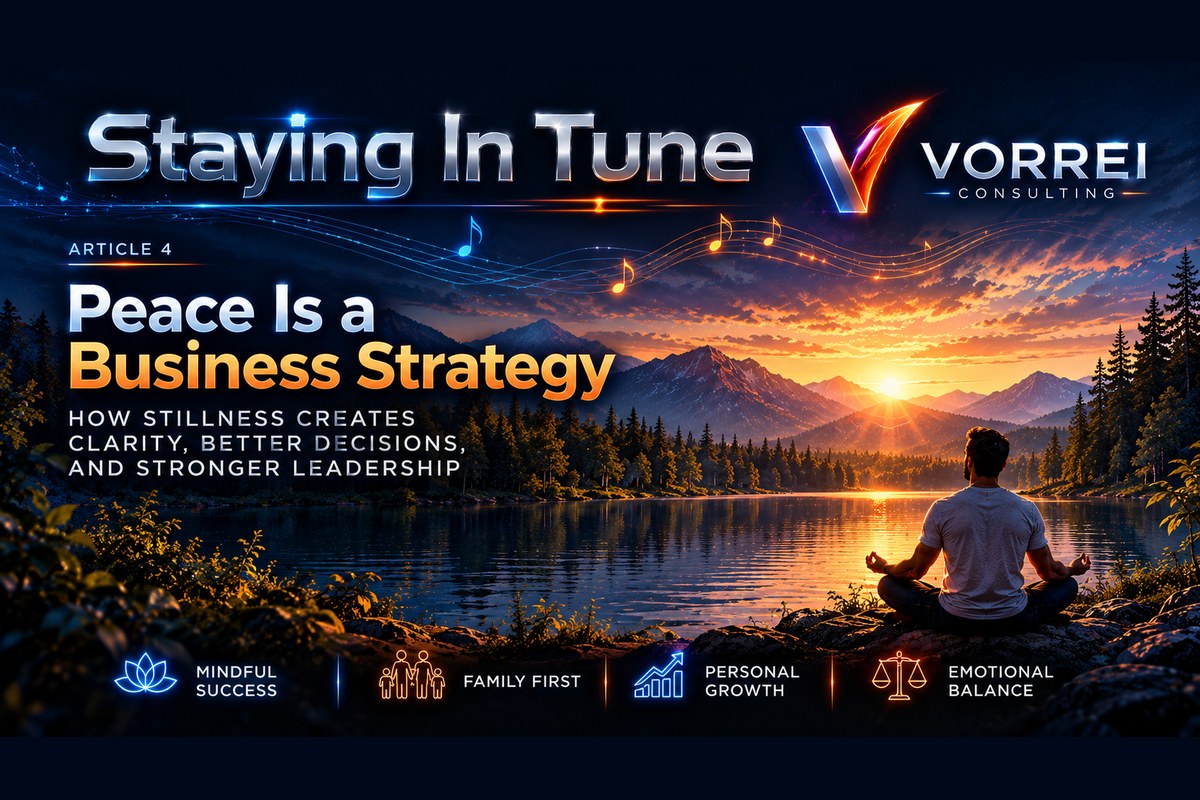
Recently, I found myself sitting beside the water, intentionally doing very little.
No strategy session.
No sales call.
No business planning.
No productivity checklist.
Just stillness.
I had spent the previous weeks moving through a significant transition.
Travel.
Change.
Uncertainty.
Decision-making.
Rebuilding.
There was plenty to process.
And I realized something:
I didn’t need another answer.
I needed enough quiet to hear the answers I already had.
We underestimate the value of stopping
In business, stopping can feel uncomfortable.
There is always something that could be improved.
Something that needs attention.
Someone who needs a response.
Another meeting.
Another metric.
Another task.
So we keep moving.
But constant movement can make it difficult to distinguish between urgency and importance.
Stillness creates separation.
It gives you the ability to step outside the immediate problem and look at the larger system.
That is incredibly valuable in leadership.
Peace creates better decisions
Think about the decisions you make when you’re stressed.
Your thinking tends to narrow.
You become reactive.
You look for immediate relief.
You may avoid difficult conversations.
You may overcorrect.
You may say yes because saying no feels uncomfortable.
You may chase an opportunity because you’re afraid there won’t be another one.
Now compare that with making the same decision after you’ve slept, taken a walk, cleared your mind, and created some distance.
The circumstances haven’t necessarily changed.
But you have.
And that changes the quality of the decision.
Stillness isn’t avoidance
This distinction matters.
Rest isn’t avoidance.
Reflection isn’t procrastination.
Meditation isn’t disengagement.
Sometimes stepping away from a problem is exactly what allows you to return to it with better judgment.
The goal isn’t to escape responsibility.
The goal is to create enough internal space to handle responsibility well.
The leadership advantage
Imagine a leader who can remain calm while everyone else is reacting.
A project goes sideways.
The team becomes frustrated.
A client changes direction.
A deadline moves.
A system fails.
A forecast changes.
The leader doesn’t panic.
They pause.
They assess.
They listen.
They ask better questions.
They determine what actually matters.
Then they act.
That calm isn’t weakness.
It’s capacity.
And teams notice it.
People take emotional cues from leaders.
When leaders operate from panic, panic spreads.
When leaders operate from clarity, clarity spreads.
Creating space for strategic thinking
Some of the best business ideas I’ve had haven’t arrived while staring at a screen.
They’ve arrived walking.
Driving.
Training.
Traveling.
Sitting quietly.
Having conversations that had nothing to do with business.
Why?
Because strategic thinking isn’t the same as task completion.
Task completion requires focus.
Strategic thinking sometimes requires space.
You need room to connect ideas.
To notice patterns.
To question assumptions.
To imagine alternatives.
To ask:
Are we solving the right problem?
Are we building the right thing?
Are we spending our energy in the right place?
What are we missing?
Those questions rarely emerge when your mind is completely saturated.
Peace doesn’t mean passivity
Peace is not the absence of ambition.
It is the absence of unnecessary internal chaos.
You can be highly ambitious and deeply grounded.
You can move quickly without being frantic.
You can make difficult decisions without being consumed by them.
You can pursue growth without sacrificing your ability to enjoy the journey.
That is the kind of leadership I increasingly believe in.
Rest. Reflect. Revamp.
I’ve started thinking about intentional pauses through three simple words:
Rest.
Recover your energy.
Reflect.
Understand what happened, what you’ve learned, and what matters.
Revamp.
Use that clarity to determine what comes next.
It’s a simple cycle.
But it can be powerful.
Because sometimes the answer isn’t another hour of work.
Sometimes the answer is a walk.
A quiet morning.
A conversation.
A day away.
A moment beside the water.
A few minutes of breathing.
A chance to simply be still.
And then you return.
Not weaker.
Not behind.
Clearer.
Maybe peace isn’t something we earn once the work is done.
Maybe peace is one of the tools that helps us do the work better.
That is why I believe peace isn’t merely a wellness concept.
Peace can be a business strategy.