By Arvell B. Anthony
One of the simplest leadership principles is also one of the hardest to practice:
Focus on what you can control.
We hear this advice all the time.
But when uncertainty arrives, most of us instinctively do the opposite.
We focus on everything we can’t control.
What will happen?
What will they decide?
Will this work?
What if it doesn’t?
What will people think?
What happens if the plan changes?
What happens if the opportunity doesn’t come?
The questions multiply.
And before long, our energy is being spent trying to solve problems that aren’t ours to solve.
The illusion of control
I’ve been reflecting on this a lot recently.
I’ve entered a new chapter of entrepreneurship after losing the stability of my previous corporate role.
There is a tremendous amount I don’t know.
I don’t know exactly which opportunities will appear.
I don’t know exactly when certain things will happen.
I don’t know which ideas will become major businesses and which ones will simply teach me something.
And I certainly can’t control how other people respond.
But I can control something much more valuable:
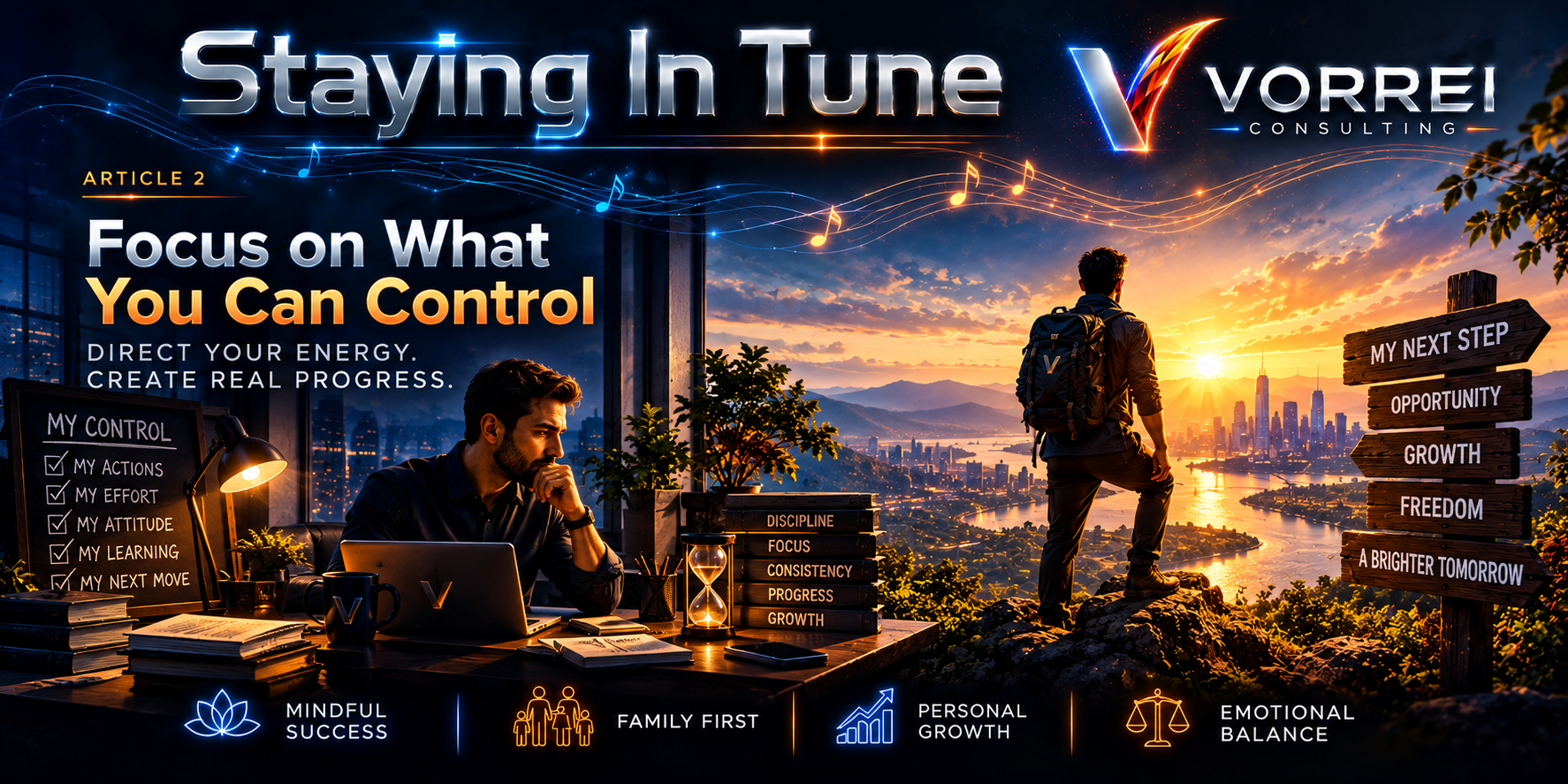
My next move.
I can control the work I do today.
I can control the quality of what I produce.
I can control how I communicate.
I can control who I reach out to.
I can control whether I continue learning.
I can control whether I follow through.
I can control how I treat people.
I can control whether I show up with integrity.
And when I focus on those things, something interesting happens.
The noise gets quieter.
Energy follows attention
Where your attention goes, your energy follows.
If you spend the morning thinking about everything that could go wrong, you’ve already spent energy on a future that doesn’t exist.
If you spend the morning thinking about what someone else might do, you’ve given your energy to someone else’s decisions.
If you spend the morning comparing your progress to someone else’s, you’ve allowed someone else’s journey to determine how you feel about your own.
But when you redirect that attention toward action, you regain something incredibly valuable:
agency.
Agency is the ability to say:
“I may not control the entire situation, but I can control what I do next.”
That’s powerful.
Leaders don’t need certainty
I’ve worked around business systems, projects, technology, teams, and organizational change for a long time.
One lesson continues to repeat itself:
The best leaders aren’t necessarily the people who have all the answers.
They’re the people who can make a good decision with incomplete information.
Business rarely gives us perfect information.
There is always another variable.
Another dependency.
Another unknown.
Another stakeholder.
Another risk.
Waiting for certainty can become its own form of procrastination.
At some point, leadership requires movement.
Not reckless movement.
Intentional movement.
You assess what you know.
You identify what you can influence.
You make the best decision available.
Then you adjust as new information arrives.
Control the process, not the outcome
This is one of the most important distinctions I’ve been thinking about.
We often measure ourselves against outcomes.
Did the client say yes?
Did the campaign work?
Did the project finish on time?
Did the opportunity materialize?
Did the investment pay off?
Those outcomes matter.
But they aren’t completely ours.
What is ours is the process.
Did we prepare?
Did we communicate?
Did we execute?
Did we follow through?
Did we learn?
Did we improve?
Did we act with integrity?
Did we give our best effort?
That is where our responsibility lives.
And ironically, becoming more focused on the process often improves the outcome.
Because we’re no longer paralyzed by the need to guarantee the result.
We’re simply committed to doing the work well.
A simple question
When I notice myself becoming overwhelmed, I’ve started asking a simple question:
“Is this something I can control?”
If the answer is yes, I ask:
“What’s the next action?”
If the answer is no, I ask:
“Why am I spending my energy here?”
That second question can be surprisingly liberating.
Not everything deserves your attention.
Not every possibility deserves your worry.
Not every opinion deserves a response.
Not every problem is yours to solve.
The business lesson
Organizations need leaders who understand this.
Teams need clarity about what they can influence.
Projects need owners who focus on actions rather than excuses.
Businesses need people who can distinguish between legitimate risks and unnecessary anxiety.
And individuals need the same discipline.
Because when everything feels uncertain, the goal isn’t to control everything.
The goal is to control what matters.
Your effort.
Your attention.
Your preparation.
Your standards.
Your decisions.
Your response.
Your next move.
That’s enough.
We don’t need to know exactly how the entire story ends before we take the next step.
We just need to make the next step count.