By Arvell B. Anthony
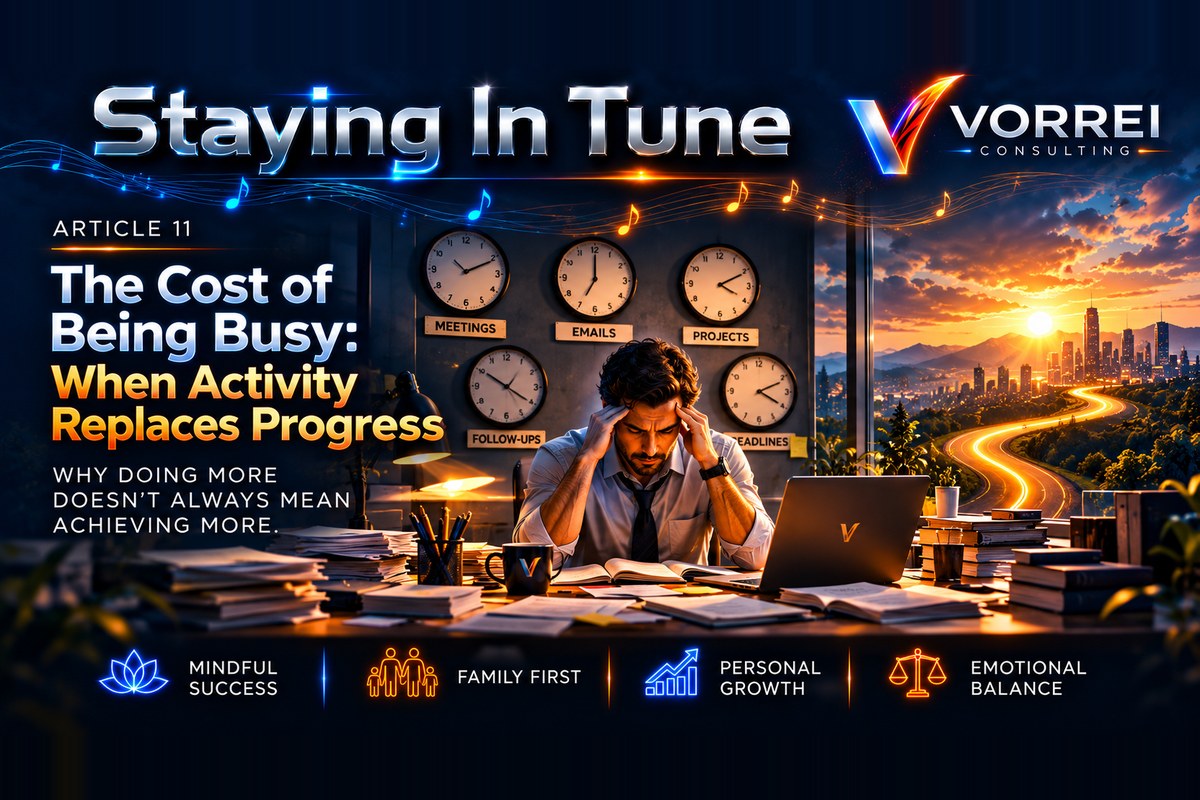
Why doing more doesn’t always mean achieving more.
There is something interesting about the way we’ve come to measure productivity.
Ask someone how their week is going, and you’ll often hear the same response:
“Busy.”
Ask a business owner how things are going, and the answer might be:
“We have a lot going on.”
Look at an executive’s calendar, and you’ll find meetings scheduled from morning until evening. Look at an employee’s workload, and you’ll find competing priorities, endless emails, multiple projects, and very little uninterrupted time to actually accomplish anything.
We’ve somehow created a culture where being busy has become a badge of honor.
But here’s a question worth asking:
What if being busy is actually preventing us from making meaningful progress?
The illusion of productivity
Activity creates the appearance of progress.
Meetings happen. Emails get answered. Reports get generated. Tasks get checked off. Conversations take place. Calendars remain full.
At the end of the day, we feel exhausted, and that exhaustion can make us believe we’ve accomplished something significant.
But exhaustion and effectiveness aren’t the same thing.
A team can spend an entire week in meetings and still make very little progress on its most important objectives.
A business can implement multiple new systems without improving the experience of its customers or employees.
A leader can spend every waking hour responding to problems without ever addressing the underlying issues creating those problems.
The organization looks active.
But is it actually moving forward?
This is where businesses need to reconsider how they define productivity.
When everything becomes a priority
One of the biggest contributors to organizational busyness is the inability to distinguish between what is important and what is simply demanding attention.
Everything becomes urgent.
Every department has competing priorities. Every stakeholder has a request. Every project has dependencies. Every email seems to require a response.
And because everything feels important, very little receives the focused attention it deserves.
The result is fragmented execution.
People move between tasks without completing meaningful work. Leaders spend their days reacting instead of directing. Teams become increasingly dependent on meetings to coordinate work that should have been clearly defined in the first place.
Eventually, the organization develops a culture of constant motion.
But motion without direction is not progress.
The hidden cost of busyness
The cost extends far beyond lost time.
It affects the quality of decisions, employee engagement, customer experiences, and ultimately business performance.
Consider what happens when people are constantly interrupted.
They have less time for deep thinking.
They make decisions with incomplete information.
They rely on shortcuts.
They become reactive.
They lose opportunities to identify better ways of working.
Over time, the organization becomes very good at maintaining activity but increasingly poor at creating meaningful improvements.
Perhaps the most concerning part is that this can become normalized.
Employees begin accepting inefficient processes as part of their jobs. Managers assume overloaded calendars are simply the reality of leadership. Executives interpret constant activity as evidence that the organization is performing.
Nobody stops to question the system itself.
Measure outcomes, not just activity
One of the most important shifts leaders can make is moving from measuring how much work is happening to understanding what that work is actually accomplishing.
Instead of asking:
How many meetings did we have?
How many tasks did we complete?
How many hours did the team work?
How many initiatives did we launch?
Start asking:
What meaningful outcomes did we achieve?
Which business problems did we solve?
What improved for our customers?
What processes became more efficient?
Which obstacles did we eliminate?
Are we closer to achieving our strategic objectives?
These questions create a different conversation.
They move the focus from activity to impact.
They also encourage accountability without relying on the assumption that more hours automatically produce better results.
Create room for meaningful work
Reducing organizational busyness doesn’t necessarily require hiring more people or implementing another productivity tool.
Sometimes it requires simplifying the way work gets done.
Start by identifying the activities consuming the most time.
Examine recurring meetings and determine whether they produce meaningful decisions or outcomes.
Review competing priorities and establish which initiatives truly deserve attention.
Clarify ownership so decisions don’t get unnecessarily delayed.
Identify processes that create repetitive work or require employees to navigate unnecessary complexity.
And perhaps most importantly, give people the space to actually do the work they were hired to do.
Efficiency isn’t about squeezing more activity into every available hour.
It’s about removing unnecessary friction so that valuable work becomes easier to accomplish.
The leadership responsibility
Leaders play a significant role in creating organizational busyness.
Every new priority, meeting, reporting requirement, approval layer, and initiative has a cost.
Even well-intentioned decisions can create unnecessary complexity when organizations don’t consider their cumulative impact.
Leadership isn’t simply about introducing more initiatives.
It’s also about having the discipline to stop doing things that no longer serve the organization.
That requires perspective.
It requires understanding the difference between what is urgent and what is important.
And it requires the courage to simplify.
A strong leader doesn’t need to keep everyone busy.
A strong leader creates the conditions for people to accomplish meaningful things.
A different definition of productivity
I’ve increasingly come to believe that we should reconsider our relationship with productivity.
We don’t need more activity for the sake of activity.
We need better decisions about where our time, attention, and resources are invested.
We need organizations that value outcomes over appearances.
We need leaders who create clarity instead of adding complexity.
And we need individuals who understand that being constantly occupied isn’t the same as being effective.
Because at the end of the day, the question isn’t how much we did.
It’s what actually changed because we did it.
Being busy fills your calendar. Being effective moves you forward.
Perhaps it’s time we stopped confusing the two.