By Arvell B. Anthony
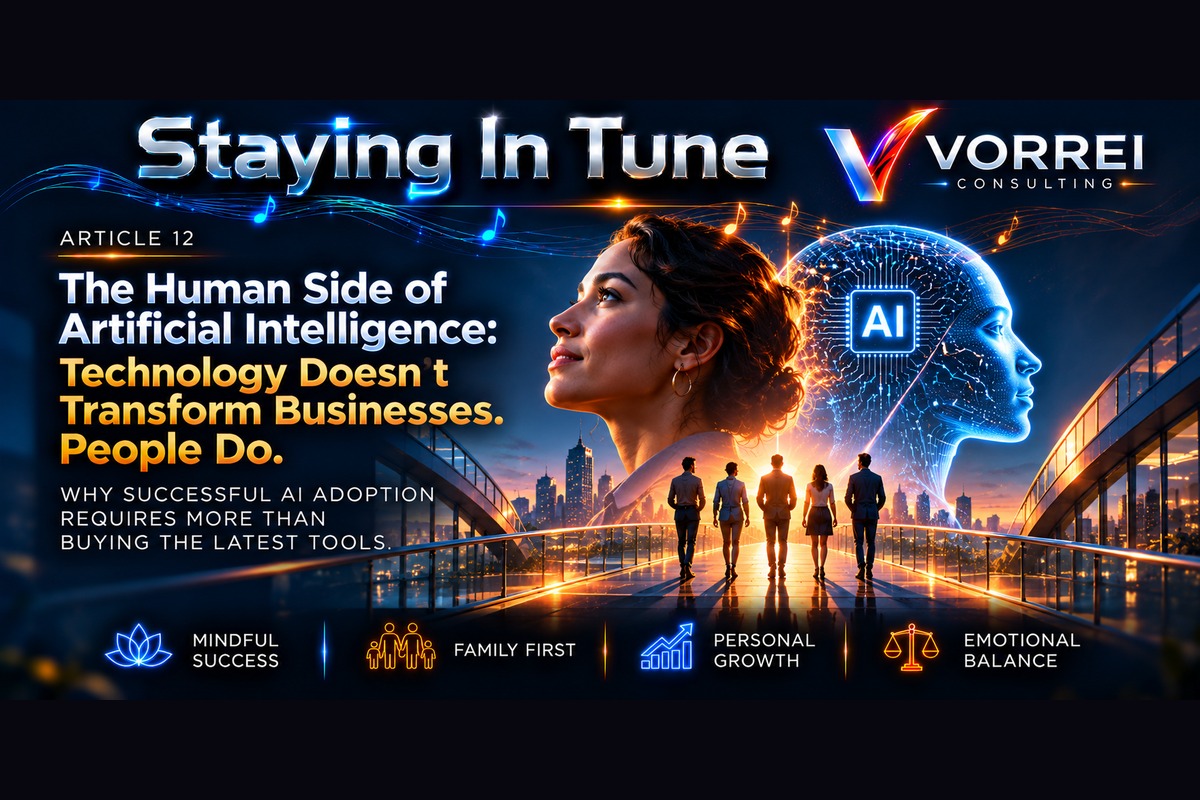
Why successful AI adoption requires more than buying the latest tools.
Artificial intelligence is changing the way businesses operate.
It’s writing content, analyzing information, automating processes, generating insights, supporting customer interactions, and helping people accomplish work that once required hours or even days.
Organizations are investing in AI platforms, exploring automation opportunities, and trying to understand how these capabilities might reshape their industries.
And understandably, there’s a tremendous amount of excitement.
But amid all the conversations about models, platforms, capabilities, and productivity gains, I think we’re overlooking something important.
Technology doesn’t transform businesses. People do.
The difference between adoption and transformation
There is a significant difference between adopting a technology and transforming the way an organization operates.
Adoption is relatively straightforward.
An organization purchases an AI subscription, provides employees with access, introduces a few tools, and encourages experimentation.
Transformation is much more involved.
It requires examining how work gets done, identifying opportunities to improve processes, reconsidering existing operating models, developing new capabilities, and helping people adapt to different ways of working.
Simply giving employees access to AI doesn’t guarantee that the organization will become more effective.
In fact, without direction, training, and thoughtful implementation, businesses can end up adding another layer of technology to processes that were already inefficient.
They may automate activities that shouldn’t exist in the first place.
They may introduce tools that don’t integrate with existing systems.
They may create new security and governance challenges.
And they may struggle to demonstrate any meaningful return on their investment.
The technology isn’t necessarily the problem.
The approach is.
The human element is the real differentiator
Every meaningful technology transformation eventually comes back to people.
Employees need to understand what is changing and why.
Managers need to understand how their teams will be affected.
Leadership needs to establish priorities, address concerns, and create a clear direction.
People need opportunities to develop new skills and become comfortable working alongside capabilities they may not fully understand yet.
This is particularly important with AI because the technology is evolving faster than many organizations can adapt.
Some employees see AI as an opportunity.
Others see it as a threat.
Some are excited about eliminating repetitive work.
Others are concerned about their roles, their relevance, and what the future of their careers might look like.
Ignoring those concerns doesn’t make them disappear.
Successful adoption requires acknowledging them.
AI should amplify human capability
One of the more interesting conversations surrounding AI is whether technology will replace people.
I think a more productive question is:
How can we make people more capable through technology?
Consider what happens when employees spend less time performing repetitive administrative tasks.
They may have more time to solve problems, work with customers, analyze information, develop relationships, and focus on activities that require human judgment.
Consider what happens when managers have better access to information.
They may be able to identify trends earlier, make more informed decisions, and spend less time manually compiling reports.
Consider what happens when business owners can leverage AI to accelerate research, planning, communication, and analysis.
They can potentially operate with capabilities that previously required significantly larger teams or budgets.
These are meaningful opportunities.
But they don’t happen automatically.
Organizations must intentionally redesign work around the capabilities technology makes possible.
Don’t automate a broken process
There is a principle in business transformation that deserves particular attention:
If a process is inefficient before automation, automating it doesn’t necessarily make it effective.
It may simply allow the organization to perform an inefficient process faster.
Before introducing AI into an operational environment, businesses should understand how their processes actually work.
Where are the bottlenecks?
Where is information duplicated?
Which activities create unnecessary administrative effort?
Where are employees spending time on repetitive tasks?
Which decisions require human judgment?
Which activities could benefit from automation?
And what should the process look like if it were designed today rather than inherited from decisions made years ago?
This is where business process improvement and AI strategy intersect.
The opportunity isn’t simply to introduce technology.
It’s to rethink how work should happen.
Leadership must establish the direction
AI adoption shouldn’t be left entirely to individual employees or isolated departments.
Without organizational direction, different teams may introduce different tools, duplicate efforts, create inconsistent processes, and expose the business to unnecessary risks.
Leadership needs to establish a framework.
That includes defining where AI can create meaningful business value, identifying appropriate use cases, establishing governance and security expectations, investing in employee education, and determining how success will be measured.
It also requires recognizing that not every problem needs AI.
Sometimes the best solution is a better process.
Sometimes it’s improved communication.
Sometimes it’s connecting systems that should have been connected years ago.
And sometimes AI genuinely offers a better way forward.
The important thing is knowing the difference.
The future belongs to adaptable organizations
I don’t believe the biggest advantage will necessarily belong to businesses with the largest technology budgets.
It will belong to organizations that can learn, adapt, experiment, and translate new capabilities into meaningful results.
That requires more than technical knowledge.
It requires curiosity.
It requires leadership.
It requires people who are willing to challenge existing assumptions and reconsider how things have always been done.
It also requires a willingness to invest in people, not just platforms.
Because technology can create opportunities, but people determine whether those opportunities become valuable.
Technology should serve the mission
As AI continues to evolve, businesses will face increasing pressure to adopt new capabilities.
But before asking which platform to purchase or which process to automate, perhaps we should start with a different question:
What are we actually trying to accomplish, and how can technology help us accomplish it better?
That question changes the conversation.
It moves the focus away from technology for technology’s sake and toward purposeful transformation.
It puts business objectives ahead of software features.
And it reminds us that the ultimate goal isn’t to create an organization that uses more technology.
It’s to create an organization that works better.
AI will continue to change the possibilities available to us.
But the organizations that benefit most will be those that understand something fundamental:
Technology creates capability. People create transformation.
And the future of business depends on getting both right.